
82 Years of Dravidar Kazhagam: The Philosophical Resurrection of Tamils and the Counterfactual Catastrophe of Its Absence
The institutionalization of Dravidar Kazhagam on August 27, 1944, at the Salem conference was neither a mere nomenclature shift nor a casual political event; it was the ultimate philosophical shield wielded by the Tamil race against the deeply entrenched hegemony of Sanatana Varnasrama and colonial structural violence. In the early twentieth century, when Brahminical supremacy coupled with colonial mechanisms attempted to dismantle the national identity and cultural sovereignty of Tamils, this progressive ideology emerged as the definitive antithesis. As an Eelam Tamil and a Dravidian Tamil nationalist, I perceive this 82nd anniversary not as a passive historical commemoration, but as an urgent philosophical reclamation of existence, sovereignty, and self-respect for global Tamils.
In a historical epoch where Brahminism rigidly stratified human existence based on birth, relegating the absolute majority of Tamils to subhuman social strata, Dravidar Kazhagam weaponized the profound philosophy of 'Self-Respect' (Suyamariyadhai). Self-Respect, within this framework, is not an individualistic psychological trait but a collective social psyche designed to obliterate institutionalized humiliation. Rejecting birth-based hierarchy on a structural level, Thanthai Periyar elevated human dignity (Humanism) far above institutionalized religious dogmas. The conceptualization of priest-less 'Self-Respect Marriages' was not merely a ritualistic rebellion; it was a radical social contract proposed to replace the patriarchal, Varnasrama marital framework, effectively restoring agency to the individual and reforming the foundational unit of society.
The movement systematically dismantled the monopoly of a privileged minority over administrative apparatuses, educational institutions, and employment spheres. The foundational maxim 'Everything for Everyone' transcended mere economic redistribution; it was the bedrock of democratic decentralization. The relentless ideological agitations of Dravidar Kazhagam necessitated the First Amendment of the Indian Constitution, which was not a routine legal modification but a monumental philosophical triumph that safeguarded subaltern existence against the reactionary judgments of caste-entrenched judiciaries. The 69 percent reservation matrix enjoyed by Tamil Nadu today stands as a direct material manifestation of this social justice philosophy.
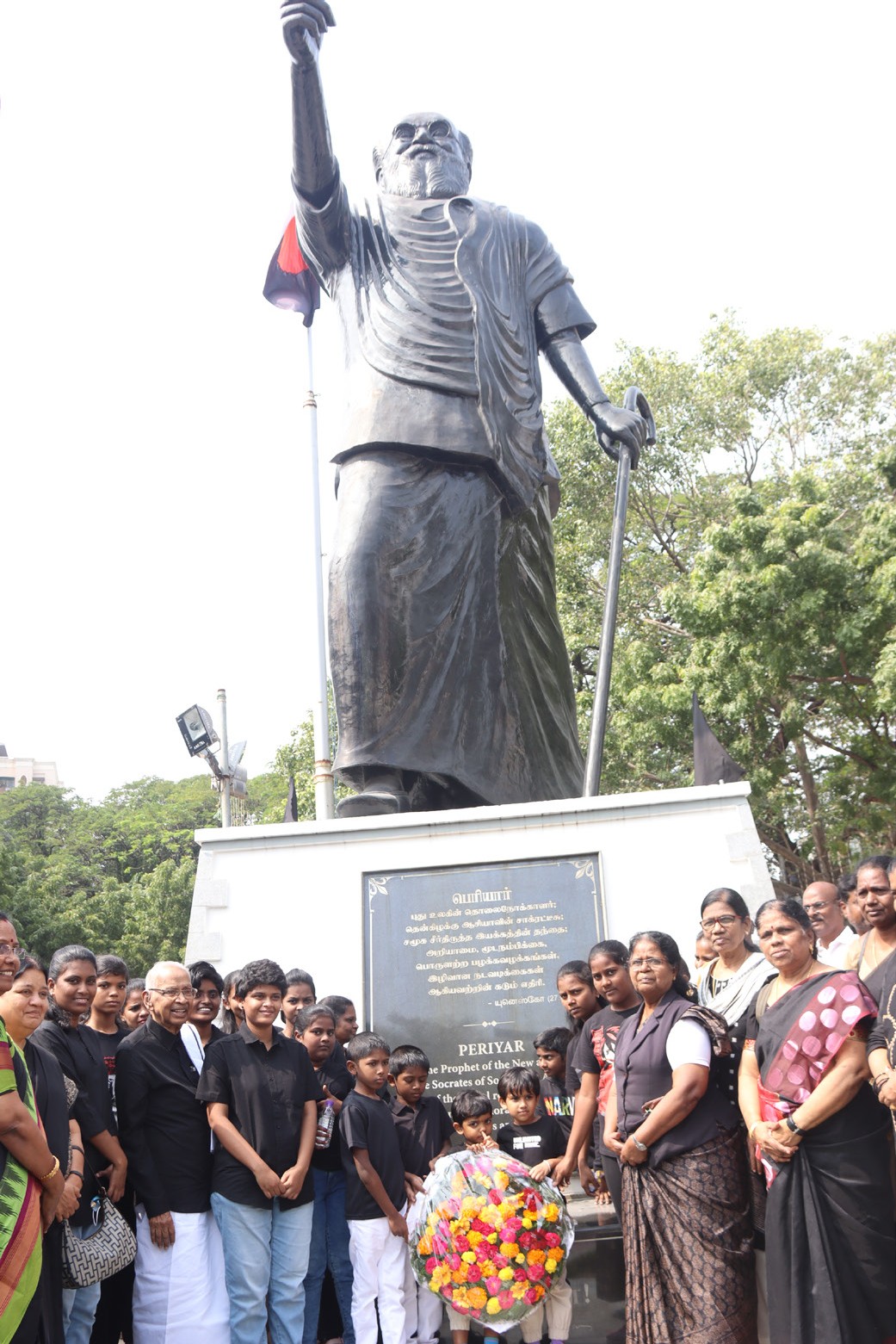
Periyar's feminist discourse did not limit itself to the liberal demand for equal rights; it launched a frontal assault on the feudal and religious architecture of the domestic unit. Dravidar Kazhagam aggressively deconstructed religious rituals, the unilateral construct of chastity, and the systemic denial of property rights, identifying them as the foundational sources of gender subjugation. The demands for women's property rights, divorce rights, and remarriage rights were profound philosophical interventions that shattered the feudal economic continuum, transforming women from passive domestic entities into active economic agents and drivers of social evolution.
The institutional imposition of Sanskrit and Hindi was astutely recognized by Dravidar Kazhagam not as a mere linguistic friction, but as an act of cultural imperialism designed to homogenize peripheral identities. The historic anti-Hindi agitations spearheaded by Periyar defended the linguistic sovereignty of Tamils. By positioning the antiquity and rationalist ethos of the Tamil language against the process of Sanskritization, the movement successfully converted language into a potent instrument of national identity and resistance.
For Eelam Tamils, the Dravidian philosophy transcends regional geopolitics, serving as a vital moral and political sanctuary for global Tamilhood.
For Eelam Tamils, the Dravidian philosophy transcends regional geopolitics, serving as a vital moral and political sanctuary for global Tamilhood. Dravidar Kazhagam consistently voiced the anxieties of oppressed populations across borders, demonstrating an unwavering ideological solidarity with the self-determination struggle of Eelam Tamils and the liberation movement led by National Leader Velupillai Prabhakaran. The movement's contribution in fostering a robust ideological and mass support base within Tamil Nadu for the liberation of the homeland remains historically unparalleled.
A critical counterfactual analysis of a Tamil Nadu devoid of Thanthai Periyar and Dravidar Kazhagam reveals a historical landscape of absolute structural catastrophe. Varnasrama Dharma and untouchability would have persisted with uncompromised legal and social sanctions, intensifying caste-bound stratification and completely suppressing marginalized existence. Institutional social justice through reservations would have been non-existent, leaving higher education and bureaucratic governance as the exclusive monopolies of a privileged caste group, while the vast majority of Tamils would remain confined to intellectual deprivation and labor exploitation. The Tamil language would have suffered systemic assimilation under Hindi and Northern cultural hegemony, reducing it to a mere dialect of domestic or ritualistic utility rather than a language of state administration and modern discourse. Regressive practices like child marriage and institutionalized religious exploitation would have stagnated societal progress, precluding women from economic independence. Politically, Tamil Nadu would have been reduced to a passive administrative appendage of Delhi-centric national parties, rendering the discourses of regional autonomy, state rights, and federalism entirely impossible.
At this juncture of completing 82 years, the legacy of Dravidar Kazhagam is not a closed chapter of the past, but an active philosophical compass for the future. For Tamil Nadu to remain the crucial moral hinterland for the liberation of Eelam Tamils, its rationalist and social justice foundations must be defended against contemporary mutations of Sanatana forces. Synthesizing Periyaristic rationalism and Dravidian social justice with the sovereign aspirations of Tamil nationalism is the definitive ideological challenge we present to the global Tamil community through the pages of 'Ezhugai'.



0 Comments